Master's Thesis: Multi-Person Human Mesh Recovery with Anny
Summary
This thesis focuses on human mesh recovery (HMR): predicting a full 3D body surface from an image or a video. Instead of returning only a few body joints, an HMR system estimates a dense mesh, which is a 3D surface made of connected vertices.
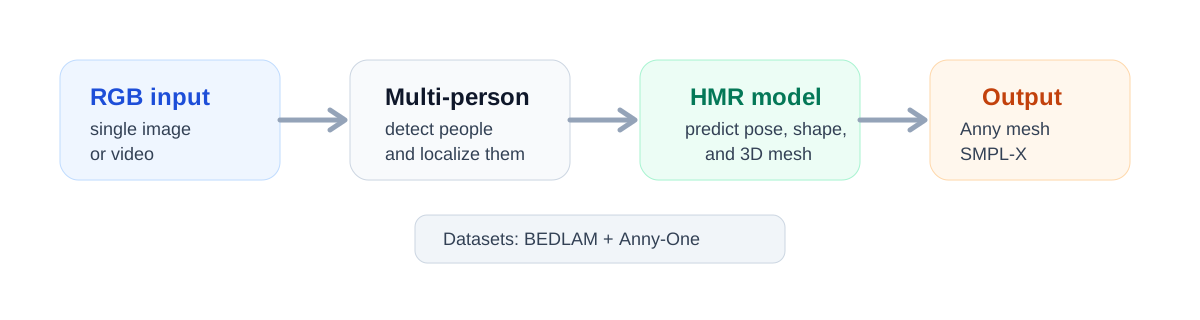
The main research target is to train HMR for the Anny body model. Anny is an open and interpretable human body model designed to cover a wider range of ages and body shapes. A secondary goal is to study compatibility with SMPL-X / SMPL, which are widely used body models in 3D human analysis.
The project will mainly study the multi-person setting, where several people appear in the same image. A possible extension is video-based HMR, where the same person must be followed across frames using tracking.
TL;DR: Build a system that reconstructs full 3D human body meshes for multiple people from images or video. The main goal is to make this work well for the Anny body model. A secondary goal is compatibility with SMPL-X / SMPL. The thesis combines deep learning, 3D vision, datasets, and efficient model design.
Glossary
| Term | Description |
|---|---|
| Human mesh recovery (HMR) | estimating a full 3D body mesh from RGB images or video. |
| Multi-person | handling several people at the same time, not just one person. |
| Body model | a parameterized template that converts pose and shape values into a 3D mesh. |
| Anny the main target model in this thesis. | |
| SMPL-X / SMPL | established body models used as references or secondary outputs. |
| Tracking | matching the same person across video frames. |
Proposed research question
Can we train an accurate and efficient multi-person HMR system for the Anny body model, and can we keep the model size significantly smaller than a strong baseline while maintaining competitive accuracy?
Expected work
- Study recent literature on multi-person HMR and body models.
- Reproduce or adapt a strong baseline for multi-person HMR.
- Train the pipeline primarily for Anny.
- Use BEDLAM and Anny-One as starting datasets, and review whether additional datasets are needed.
- Evaluate accuracy, runtime, and model size.
- Optionally extend the system from single images to video by adding temporal consistency or tracking.
Main datasets and models
- Anny / Anny-One for the primary body-model target.
- BEDLAM for large-scale synthetic supervision with 3D body annotations.
- SMPL-X / SMPL for comparison, interoperability, or secondary output support.
- Multi-HMR as a likely starting reference for the multi-person setting.
Target outcome
A successful thesis should deliver:
- a clean training and evaluation pipeline,
- a model that works on multi-person RGB scenes,
- primary support for Anny,
- an analysis of accuracy vs. efficiency,
- and, if time permits, a video extension with tracking.
A stretch goal is to reach roughly 50% of the parameter count of a strong baseline while keeping similar or better accuracy.
Who this thesis is for
This topic is suitable for a student who is comfortable with:
- Python and PyTorch,
- deep learning for computer vision,
- reading recent research papers,
- and implementing clean, reproducible experiments.
Useful starting references
Maintained by saifkhichi96 on GitHub.
The website is distributed under different open-source licenses. For more details, see the notice at the bottom of the page.