Real-time human avatar animation from markerless 3D joint tracking
Abstract
Inverse kinematics (IK) is a core operation in animation, robotics, and biomechanics: given Cartesian constraints, recover joint rotations under a known kinematic tree. In many real-time human avatar pipelines, the available signal per frame is a sparse set of tracked 3D joint positions, whereas animation systems require joint orientations to drive skinning. Recovering full orientations from positions is underconstrained, most notably because twist about bone axes is ambiguous, and classical IK solvers typically rely on iterative optimization that can be slow and sensitive to noisy inputs. We introduce IK-GAT , a lightweight graph-attention network that reconstructs full-body joint orientations from 3D joint positions in a single forward pass. The model performs message passing over the skeletal parent-child graph to exploit kinematic structure during rotation inference. To simplify learning, IK-GAT predicts rotations in a bone-aligned world-frame representation anchored to rest-pose bone frames. This parameterization makes the twist axis explicit and is exactly invertible to standard parent-relative local rotations given the kinematic tree and rest pose. The network uses a continuous 6D rotation representation and is trained with a geodesic loss on SO(3) together with an optional forward-kinematics consistency regularizer. IK-GAT produces animation-ready local rotations that can directly drive a rigged avatar or be converted to pose parameters of SMPL-like body models for real-time and online applications. With 374 K parameters and over 650 FPS on CPU, IK-GAT outperforms VPoser-based per-frame iterative optimization without warm-start at significantly lower cost, and is robust to initial pose and input noise.
Teaser
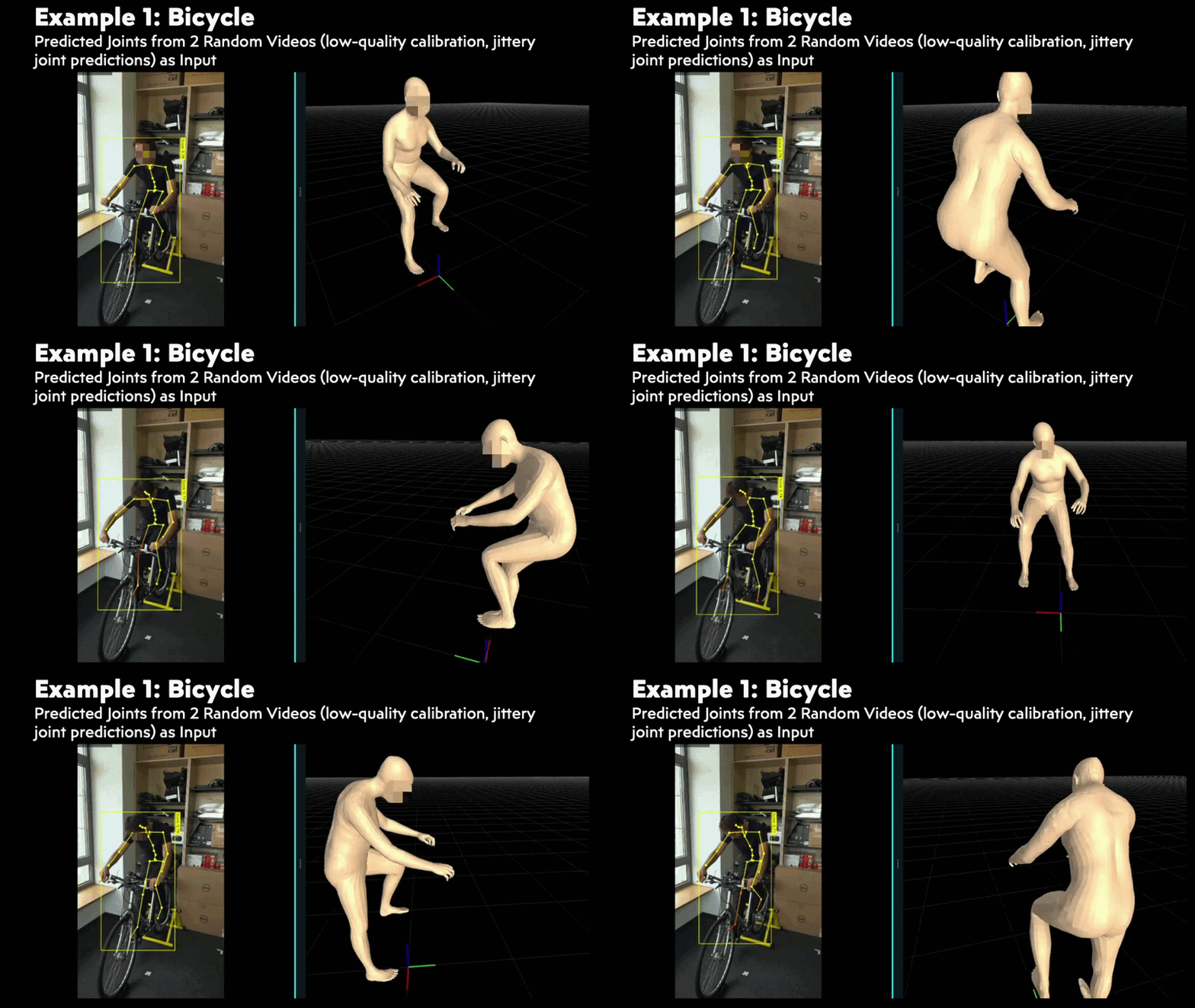
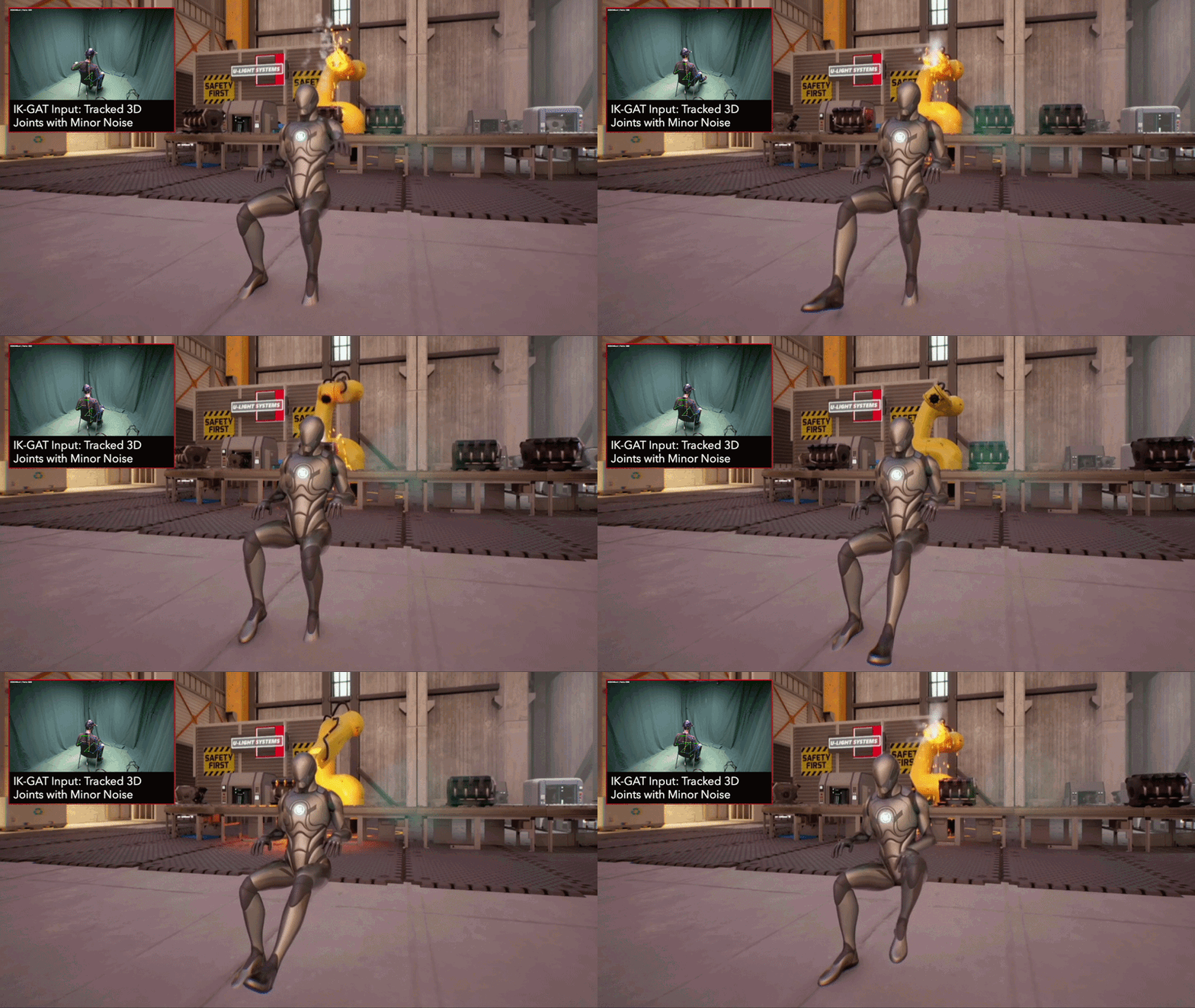
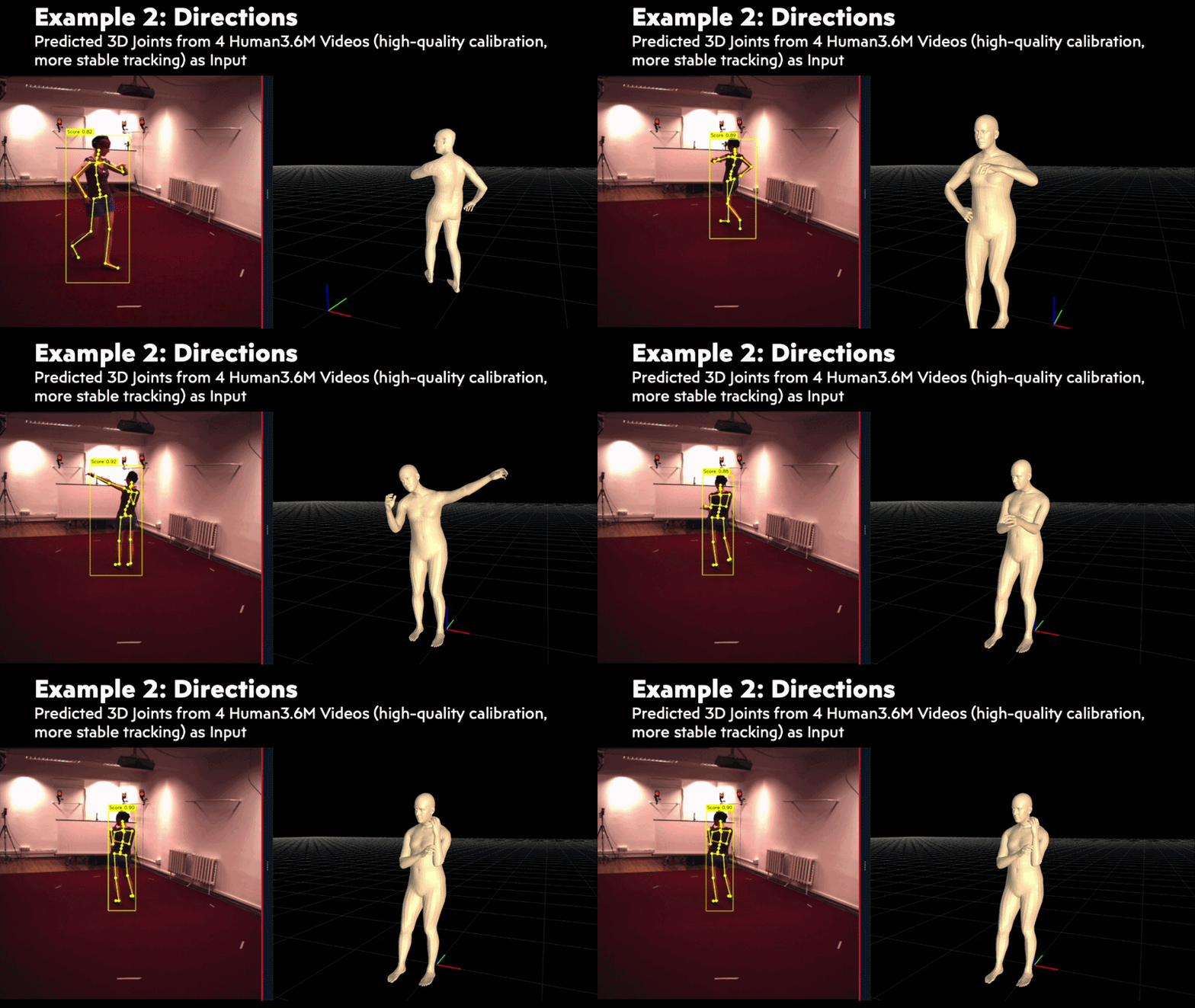
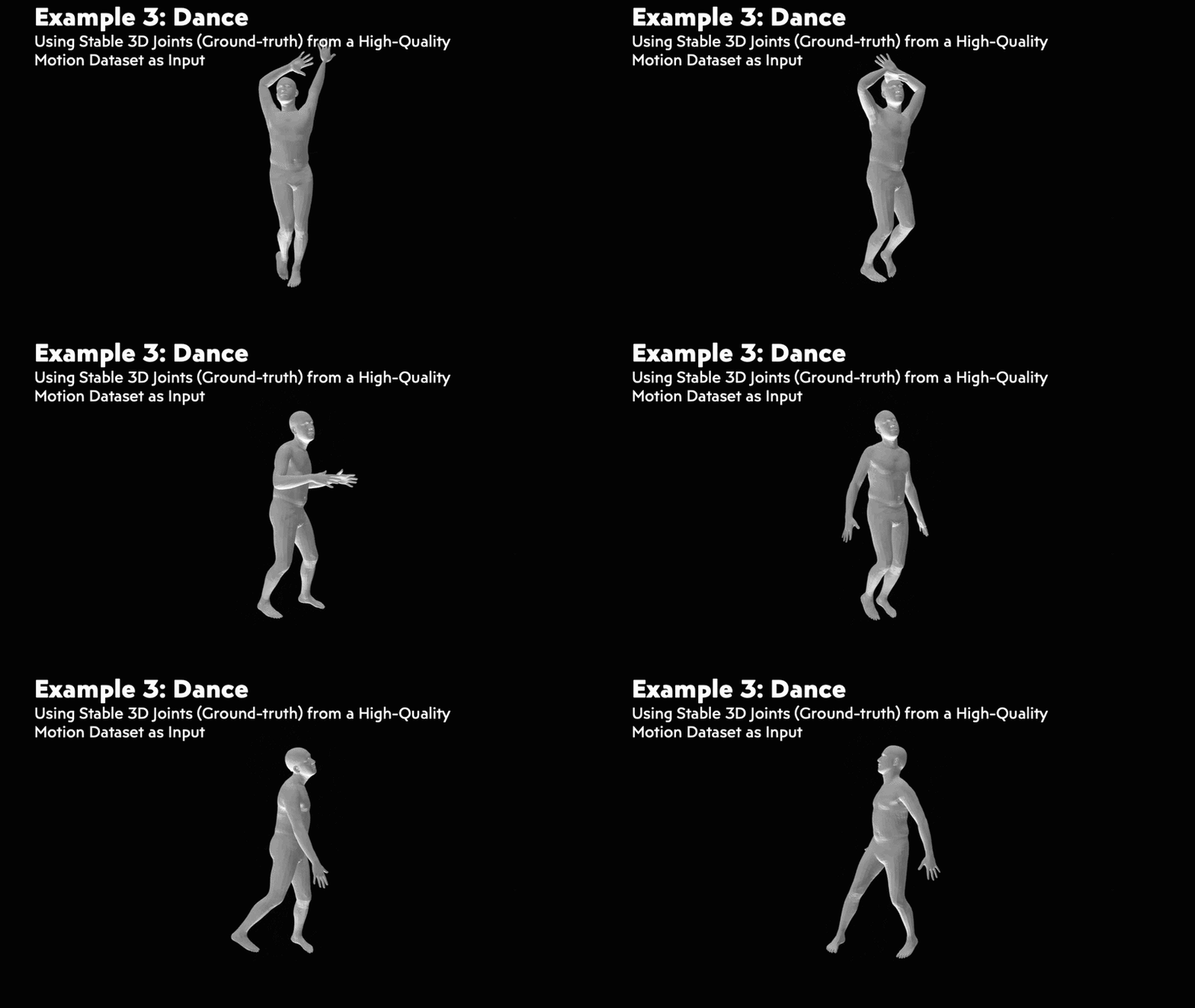
IK-GAT can create animations (right) from 3D joint positions as input (left) in real time. The positions can come from any upstream tracking system.
Demos
Poster Abstract
This work was also presented at the ACM SIGGRAPH / Eurographics Symposium on Computer Animation 2026 in Barcelona, Spain as a poster entitled Dense Orientation Recovery via Lightweight Graph Attention for Real-Time Avatar Animation from Markerless Tracking.
Grant Information
This project has received funding from the European Union’s Horizon Europe research and innovation programme under grant agreement No [101135724] (LUMINOUS); [101298864] VICTOR-XR; addressing Topic [HORIZON-CL4-2023-HUMAN-01-21]. The funders had no role in study design, data collection and analysis, decision to publish, or preparation of the manuscript.
BibTeX
@article{khan2026amortized,
  title        = {Amortized Inverse Kinematics via Graph Attention for Real-Time Human Avatar Animation [version 1; peer review: awaiting peer review]},
  author       = {Khan, MSU and Wang, CY and Prokosch, T and Lorenz, M and Taetz, B and Stricker, D},
  year         = 2026,
  journal      = {Open Research Europe},
  volume       = 6,
  number       = 314,
  doi          = {10.12688/openreseurope.24416.1}
}
@inproceedings{khan2026dense,
  title        = {Dense Orientation Recovery via Lightweight Graph Attention for Real-Time Avatar Animation from Markerless Tracking},
  author       = {Khan, MSU and Wang, CY and Prokosch, T and Lorenz, M and Taetz, B and Stricker, D},
  year         = 2026,
  booktitle    = {SCA 2026: ACM SIGGRAPH / Eurographics Symposium on Computer Animation - Posters},
  publisher    = {The Eurographics Association},
  doi          = {10.2312/sca.20261002},
  editor       = {Sugimoto, R.}
}